

Is a Betting App Legal in India? A Gamer’s Guide to the Grind and the Law
So, you wanna know if it’s cool to use a betting app in India? Straight up, the answer is a big, fat “it’s complicated.” There’s no simple yes or no. The law is like a legacy server running on a super old central act, patched with a bunch of modern, state-level rules. It’s a real mess.
A Player’s Guide to India’s Betting App Laws
Think of India’s legal system for online betting like a massive open-world map where each state has its own unique ruleset. This setup goes way back. The core law, the Public Gambling Act of 1867, was written for IRL gambling dens, way before the internet was even a thing. This left online betting in a huge grey area, basically an unpatched exploit.
Because of this, each state has been free to drop its own hotfixes, creating a totally different gameplay experience depending on where you’re logged in from. You can get a deeper look at this legal maze on The Daily Brief.
This guide will be your walkthrough for this complex map. We’ll break down the critical difference between ‘games of skill’ and ‘games of chance’—the single most important concept that decides if an app is legit or a permaban waiting to happen.
The Mission Briefing: What This Guide Covers
Before you even think about downloading an app, you need to know the local server rules. Some states have opened up their servers to online gaming with official licensing systems, while others are strictly off-limits.
- The Green Zones (PvP Enabled): We’ll check out which states are player-friendly, like Sikkim and Nagaland, which have led the way in licensing skill-based games.
- The Red Zones (Permaban Areas): We’ll also flag the states you need to avoid, like Tamil Nadu and Andhra Pradesh, where using a betting app could get you kicked from the server for good.
- The Core Rulebook: Most importantly, this guide will explain the legal difference between skill-based games (like fantasy sports) and chance-based games (like online roulette). Understanding this is meta—it defines what you can and can’t legally play.
- The Latest Patch Notes: We’ll also cover recent changes that affect everyone, like the introduction of the 28% GST on all deposits, which nerfs your starting bankroll big time.
By the time you finish this guide, you’ll have a clear picture of India’s complex legal environment. You’ll be able to spot legit platforms and dodge the ones that are just out to grief your wallet. Let’s get started.
The Big Question: Skill vs. Chance
At the core of India’s betting laws is one key distinction: is the game a “game of skill” or a “game of chance”? This isn’t just a minor detail; it’s the entire foundation of what’s considered legal. It’s the difference between a high-skill FPS and a loot box.
A game of skill is one where your knowledge, strategy, and experience are the main factors that determine whether you win or lose. Think fantasy cricket or rummy. Sure, there’s some RNG, but a skilled player will consistently frag a noob over time.
A game of chance, on the other hand, is all about luck. Think of a slot machine or a roulette wheel. No amount of practice or strategy can influence the outcome. The result is pure RNG.
This distinction matters because the Supreme Court of India has ruled that games of skill are not “gambling” and are protected as legit business activities. This is the legal loophole that allows apps for fantasy sports and rummy to operate in many states.
Here’s a quick table to help you remember the difference:
Quick Legal Status Check: Skill Vs. Chance
| Game Type | Legal Status | Why It Matters |
| Game of Skill | Generally Legal | The outcome relies more on your expertise, strategy, and game sense than pure luck. This is why fantasy sports and rummy are often allowed. It’s about your build, not your drops. |
| Game of Chance | Generally Illegal | The outcome is determined by pure RNG, like a lottery or a slot machine. These fall under gambling laws and are restricted in most states. It’s a pure loot box mechanic. |
Basically, if an app focuses on games where your brain is the ultimate weapon, it has a much better chance of being legal. If it’s all down to a lucky spin, it’s probably bannable.
The Core Mechanic: Skill Versus Chance
To get your head around whether a betting app is legal in India, you first need to grasp the one thing the law truly cares about: the difference between skill and chance. This isn’t just some minor detail; it’s the very foundation of an app’s legal standing. Think of it like the difference between a tactical shooter and a slot machine.
A ‘game of skill’ is one where your expertise and decisions heavily influence the outcome. You bring your knowledge, strategy, and quick thinking to the table. The Indian Supreme Court generally views these as legitimate business activities, not pure gambling. It’s the eSports of betting.
On the other hand, a ‘game of chance’ is exactly what it sounds like—all about RNG. The result is completely random. These are almost always considered gambling and are banned under most state laws.
How Courts Define the Playing Field
Landmark court cases have really set the stage here, creating the rules that platforms now follow. The biggest takeaway from these legal boss battles is something called the “predominance test.” If skill is the main stat for winning, the game usually gets a green light.
This is exactly how fantasy sports platforms like Dream11 made their case and won. They successfully showed that winning requires a deep understanding of player stats, team strategies, and match conditions—a lot more than just a lucky guess. That victory opened the doors for fantasy sports to operate legally across much of the country.
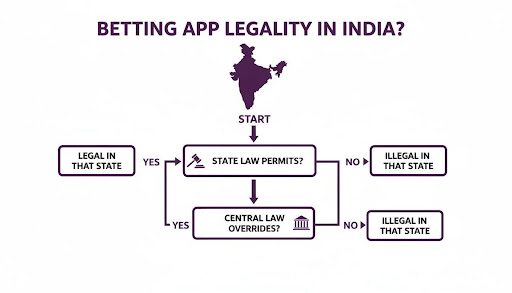
But it’s not always black and white. For instance, games like poker and rummy are often seen as skill-based, yet some states have still banned them. It just goes to show how much the server rules can change from one region to another. This flowchart breaks down how an app’s legality is a mix of both central and state-level laws.
As you can see, there’s no single “yes” or “no” answer. An app’s legal status completely depends on which state’s rulebook you’re playing by.
The Skill vs. Chance Gauntlet
So, how do you figure out if an app is on the right side of the law? You need to learn how to spot the difference between a real skill challenge and a game that’s just a roll of the dice. Here’s a quick checklist to help you out:
- Player Control: In a skill game, your choices matter. You’re building a team, making a strategic move, or placing a bet based on solid info. In a chance game, you just push a button and hope for a lucky drop.
- Predictability: While you can’t predict everything, skill-based games let you make educated guesses. A pro player will almost always have a better win rate over the long run. It’s about a high K/D ratio, not a one-off lucky headshot.
- Knowledge Requirement: Does the game reward you for doing your homework? Fantasy sports, for instance, are great for players who love digging into player stats and form. A slot machine couldn’t care less about your research.
This table gives a clearer picture of how different states are handling online betting.
State-By-State Betting Law Leaderboard
Here’s a quick comparison of online betting rules across some key Indian states, showing you where it’s legal and what to watch out for.
| State | Legal Stance on Online Betting | Key Regulations Or Bans | Permitted Games (If Any) |
| Maharashtra | Complex; online betting is not explicitly legal, and the Maharashtra Prevention of Gambling Act is strict. | The law from 1887 doesn’t mention online platforms, creating a grey area. | Primarily horse racing and lottery. Fantasy sports are generally considered skill-based. |
| Sikkim | Legal and regulated. One of the few states with a clear licensing framework. | Issues licenses for online sports betting and casino games under the Sikkim Online Gaming (Regulation) Act. | Sports betting, casino games like poker and blackjack, and lottery. |
| Goa | Legal, with a focus on land-based casinos, but online betting falls into a legal grey zone. | Most regulations are aimed at physical casinos. Online platforms operate without specific state licenses. | Casino games (mostly offline), lottery. Online skill games are generally accepted. |
| Telangana | Banned. The state has some of the strictest anti-gambling laws in the country. | The Telangana Gaming (Amendment) Act of 2017 bans all forms of online gaming for stakes, including skill games. | None. All forms of real-money online gaming are illegal. |
| Karnataka | Online skill games are legal, but a recent attempt to ban all online gaming was struck down. | The High Court struck down a 2021 amendment that tried to ban online games of skill. | Games of skill like fantasy sports and rummy are permitted. |
As you can see, the map is incredibly varied. What’s perfectly fine in one zone could be completely illegal just across the border. Always check the local server rules for your specific state before you start playing.
How Central and State Laws Clash Over Gaming
Trying to figure out if a betting app is legal in India can feel like a massive tug-of-war. On one side, you have the central government, and on the other, you have the individual states. For years, the central government mostly stayed on the sidelines, letting each state call the shots on gambling. This hands-off approach is exactly why we have such a patchwork of different rules across the country today.
This ongoing turf war is the core reason why what’s perfectly legal in one part of India could get you into serious trouble just one state over. It’s a classic case of two different rulebooks, and it directly affects whether you can legally place a bet on your phone.
The Green Zones and The Red Zones
Since every state has the authority to create its own gambling laws, India has become a mix of “green zones” where betting is allowed and regulated, and “red zones” where it’s strictly forbidden. It’s absolutely crucial to know which zone you’re in before you start playing.
Two of the most well-known green zones are Goa and Sikkim. These states decided to carve their own path, setting up legal frameworks for gaming. Sikkim, for instance, even issues specific licences for online sports betting, but only for operations within its borders. Think of them as special event servers with officially approved mods.
Then you have the red zones, like Andhra Pradesh, Telangana, and Tamil Nadu. These states have taken the opposite approach, dropping the ban hammer on all forms of online gaming involving real money. Using a betting app in these regions is a high-risk activity, as they have a zero-tolerance policy.
This state-by-state approach means there is no single, straightforward answer to whether a betting app is legal in India. Your physical location is the most critical factor, so understanding your local server rules is non-negotiable.
The Central Government Enters the Fray
More recently, the central government has decided to jump into the match, trying to bring some level of national consistency to the online gaming world. Its most significant move was introducing the Information Technology (IT) Rules, which are designed to create a baseline set of guidelines for all online gaming platforms.
But instead of simplifying things, this has just added another layer of complexity. Here’s a quick breakdown of the current power dynamic:
- State Power: According to the Constitution, states still have the primary authority to make laws on “betting and gambling.” This is their turf.
- Central Influence: The central government, however, controls laws related to information technology and the internet, allowing it to regulate the digital platforms that host the games.
- The Resulting Conflict: This overlap creates a legal grey area. A state might have a blanket ban on online gaming, but an app operator could argue they are compliant with the central IT rules, sparking court battles and leaving players caught in the middle.
This constant push and pull means the legal meta is always shifting. An app that works today might be blocked tomorrow because of a new state law or a central directive. For you, the player, the only way to stay safe is to keep a close eye on the patch notes from both your state and the central government.
How to Spot Legit Platforms and Avoid Scams
The online world is packed with cheaters and hackers, so how can you tell a genuine, compliant betting app from a scam designed to drain your wallet? Finding a betting app legal in India means you have to do a little recon first. Think of it as your personal pre-game lobby check, making sure everything is secure before you ready up.
You’ve got to have a sharp eye for detail here. Shady platforms are often designed to look like the real deal, but there are always a few tell-tale signs that give them away. A legitimate app will be transparent about how it operates, while a scam will be vague and try to rush you into making risky moves.
Your Ultimate Legitimacy Checklist
Before you even think about putting any real money down, run every potential app through this essential checklist. If an app fails even one of these checks, that’s a massive red flag. You should probably just bail.
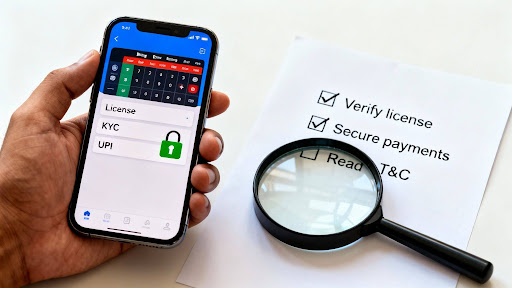

- Check for a Valid Licence: Legit platforms aren’t shy about their credentials. They’ll display their licence info clearly, usually from a recognised international authority like Malta, Curaçao, or the UK. If you can’t find any licensing details, that’s a critical warning.
- Scrutinise Payment Methods: Trustworthy apps use secure, well-known payment gateways. You want to see options like UPI, Net Banking, and reputable e-wallets. Scams, on the other hand, often push you toward obscure e-wallets or crypto-only transactions that are much harder to trace.
- Verify KYC Policies: Know Your Customer (KYC) is a standard, non-negotiable procedure for any legitimate financial platform. If an app requires you to verify your identity with official documents, that’s a good sign. It shows they are serious about following anti-money laundering rules. An app that lets you deposit and play with zero verification is highly suspicious.
- Read the User Reviews: See what other players are saying, but be smart about it. Look for detailed reviews on independent sites, not just the glowing five-star ratings on the app store. If you see a pattern of complaints about delayed withdrawals or locked accounts, that’s a huge problem.
For newcomers, figuring all this out can feel like a lot. If you’re just starting, you can find more guidance in our article covering top tips for online gambling newcomers, which offers some practical advice.
The Non-Negotiable Rules of Engagement
Beyond those initial checks, there are a few golden rules you should never break. These habits separate savvy players from easy targets and are absolutely crucial for protecting your money and personal information.
Think of the terms and conditions as the game’s rulebook. Skipping it is like walking into a boss fight without knowing its attack patterns—you’re just setting yourself up for failure. Legit platforms have clear rules; scams hide unfair clauses in the fine print.
Pay close attention to the withdrawal policies. Unrealistic bonus offers with impossible wagering requirements are a classic scam tactic. A legit platform will have achievable bonus conditions and transparent timelines for withdrawals. If an offer seems too good to be true, it’s probably a trap.
Responsible Gaming Features Are a Must
Finally, a key sign of a platform’s legitimacy is its commitment to responsible gaming. Reputable operators get it—betting should be a fun pastime, not something that causes harm. They provide tools to help you stay in control.
Look for these essential features:
- Deposit Limits: The ability to set daily, weekly, or monthly limits on how much you can deposit.
- Self-Exclusion: An option to temporarily or permanently ban yourself from the app if you feel your habits are becoming unhealthy.
- Reality Checks: Pop-up reminders that show how long you’ve been playing and how much you’ve wagered.
If an app doesn’t offer these tools, it signals that the operator doesn’t care about its players’ well-being. It means they’re only interested in farming as much money from you as possible, which is the hallmark of a predatory platform. Sticking to apps that promote safe play is the best way to ensure your gaming experience stays positive.
Your Responsibilities: Taxes, Payments, and Playing Safe
Being a successful player isn’t just about picking winners; it’s also about handling your loot smartly once you’ve won. As soon as you start cashing out, you’ve got to think about taxes and payments. Getting this right is crucial for keeping your account in good standing and staying out of legal trouble.
The Indian government has clear rules about winnings from online games. This isn’t an optional side-quest—it’s a mandatory part of playing. If you ignore the rules, you could face serious penalties, so it’s vital to understand exactly what’s expected of you.
Understanding the Tax on Your Winnings
Think of taxes on your winnings as a non-negotiable raid mechanic. The government’s system is straightforward, and every player has to follow it. Pleading ignorance won’t save you, so let’s break down the two main taxes you need to know about.
First up is Tax Deducted at Source (TDS). Any net winnings you make from an online game are hit with a flat 30% tax. The platform you’re using is legally required to cut this tax before sending you your cash. So, if you win ₹10,000, they’ll deduct ₹3,000 for TDS, and you’ll receive ₹7,000. It’s an automatic debuff you need to factor into your earnings.
The second, and far more controversial, tax is the 28% Goods and Services Tax (GST). This one stings because it’s charged before you even place a bet.
The 28% GST is applied to the full amount of every deposit you make. So, if you deposit ₹1,000 into your account, ₹280 is immediately taken as GST. That leaves you with just ₹720 to play with. This has been a massive point of frustration for both players and the industry, as it makes the grind significantly more expensive from the get-go.
Managing Your Money and Staying Compliant
Handling your funds correctly is just as important as your in-game strategy. Legitimate platforms will always stick to secure and regulated payment methods. This is one of the clearest signs that you’re playing on a site that follows the rules.
Here’s what you need to remember to keep your transactions smooth and legal:
- Use Approved Channels: Always use well-known payment methods like UPI, Net Banking, and trusted e-wallets. These are regulated, secure, and leave a clear paper trail.
- Watch Out for Red Flags: If a site is pushing you towards unregulated crypto transfers or shady e-wallets you’ve never heard of, be very careful. These are often used to sidestep regulations and could put your money at risk.
- Keep Good Records: It’s smart to keep a log of all your deposits and withdrawals. This not only helps you track your spending but also serves as proof if any issues ever come up.
Playing Safe: The Responsible Gaming Mindset
Finally, the most important responsibility you have is to yourself. The whole point of betting is to have fun, not to let it become a stressful grind that messes with your real life. Adopting a responsible gaming mindset is what separates casual players from smart ones.
This means knowing when to stop and take a break. Most reputable platforms offer tools to help you stay in control, like letting you set deposit limits or self-exclude for a period. Use them. Set a budget before you start playing and stick to it, just like you’d manage your in-game currency. Remember, the best players are the ones who know their limits and are in it for the long run—both in the app and in life.
The Future of Betting Apps in India
The legal landscape for betting apps in India feels like it’s constantly getting patched, much like a live-service game. So, what’s on the roadmap for the next big update? The entire industry is watching closely for meta shifts that could completely change how players across the country engage with these platforms.
The single biggest game-changer could be the growing push for a unified central regulatory body. For years, the scene has been a bit chaotic, with each state essentially running its own server with its own set of rules. A central authority would finally bring some much-needed consistency, ending the state-by-state confusion and creating a clear, nationwide rulebook for what makes a betting app legal in India.


Towards a Regulated and Licensed Market
Many industry experts believe India is inching towards a licensed and regulated sports betting market, similar to the systems you see in the UK or parts of the US. A move like this would be a massive level-up for both player safety and the stability of the industry itself.
Instead of operating in murky legal grey areas, platforms would have to get official licences, follow strict standards, and contribute taxes. This shift would give players the legal protection they’ve been missing and ensure everyone is playing on a fair server. Projections showing India’s online gaming sector could hit $8.6 billion by 2027 only add more weight to the arguments for proper regulation.
Tech Innovations on the Horizon
The next-gen betting platforms will almost certainly be shaped by new technology that makes the experience safer and more transparent for everyone. We’re not talking about simple cosmetic upgrades; these are fundamental changes to how the systems work.
- Artificial Intelligence (AI): AI algorithms can be put to work detecting fraudulent activity and promoting responsible gaming. They can spot problematic player behaviour in real-time and intervene, like an anti-cheat system for bad habits.
- Blockchain Technology: Blockchain could bring incredible transparency to every transaction. Imagine a secure, verifiable ledger of all bets and payouts—that’s the kind of thing that builds massive trust with players.
Bringing in tech like AI and blockchain isn’t just a gimmick. It represents a real shift toward creating a more secure, fair, and accountable gaming environment for Indian players, pulling the industry out of the shadows and into a properly regulated future.
Ultimately, the future of betting apps in India is pointing toward one thing: greater clarity and regulation. The current fragmented system just isn’t sustainable, and everyone from players to legitimate operators is calling for a more structured approach. While no one knows the exact timeline, the momentum is building for a major overhaul that will redefine the rules of the game for years to come.
Frequently Asked Questions
Figuring out the rules for betting apps in India can feel like navigating a buggy questline. To help you get a clearer picture, we’ve answered some of the most common questions people have, so you can play with confidence.
Are Offshore Betting Apps Like Bet365 or 1xBet Legal?
This is probably the biggest grey area in India’s online betting scene. Since platforms like Bet365 and 1xBet operate from outside India, our laws don’t directly reach them. But that doesn’t mean it’s a safe bet to use them.
The real hurdle is the Foreign Exchange Management Act (FEMA). This law throws a wrench in the works by putting strict limits on sending money abroad for betting. This can create major headaches when you’re trying to deposit or withdraw funds. While the government doesn’t usually go after individual players, it has blocked access to these sites before and isn’t shy about cracking down on payment processors that help move the money.
Think of it this way: you’re playing in a PvP zone with no rules or moderators. If something goes wrong—say, the platform won’t pay out your winnings—you have zero legal support in India to back you up.
What Happens If I Use an App in a Banned State?
Honestly, this is a risk you just shouldn’t take. If you use a betting app in a state like Tamil Nadu or Andhra Pradesh where there’s a clear ban, you’re breaking local law. The consequences are no joke—they can range from big fines to, in some scenarios, even jail time. It’s a potential permaban from real life.
State governments have the authority to tell internet providers to block these apps and can order payment companies to freeze any related transactions. While it’s true that enforcement against single users isn’t always consistent, the risk is very real. The smartest move? Always follow your local state’s laws to stay out of legal trouble.
Is It Legal to Bet on Fantasy Sports Like Dream11?
For the most part, yes. Fantasy sports have a much clearer legal standing in most of India. The Supreme Court and various High Courts have consistently said that platforms like Dream11 are ‘games of skill’, not ‘games of chance’.
This distinction is everything. It’s what legally separates fantasy sports from straight-up gambling. But it’s not a free pass everywhere. A handful of states have put blanket bans on all real-money online gaming, and sometimes fantasy sports get caught in that net. So, it’s always a good idea to quickly check your state’s specific rules before you start building your team.
How Is the 28 Percent GST Calculated on Betting Apps?
The 28% GST has been a game-changer, and not in a good way for players. The tricky part is how it’s calculated: the tax is slapped on the full value of every single deposit you make.
It’s not a tax on your winnings or the platform’s fee—it comes directly out of your deposit before you even place a bet. Let’s break it down:
- You decide to deposit ₹1,000 into your account.
- A 28% GST of ₹280 is instantly cut from that amount.
- You’re left with just ₹720 to actually play with.
As you can imagine, this has drawn a lot of fire from both players and the gaming industry because it’s a massive nerf to your starting funds.